
The Global Carbon Project (GCP) releases the Global Carbon Budget 2025
The Global Carbon Budget 2025 has been published in the journal Earth System Science Data on 13 May 2026. ESSD
The Global Carbon Project (GCP) is an international research project within the Future Earth research initiative on global sustainability, and a research partner of the World Climate Research Programme. It aims to develop a comprehensive assessment of the global carbon cycle, including both its biophysical and human dimensions, together with the interactions and feedbacks between them.
GCP releases the Global Carbon Budget (GCB) annually, consolidating various methodologies and quantifying carbon budgets. The Global Carbon Budget 2025 (GCB2025) is the 20th edition of the annual update, which started in 2006. In GCB2025, more than 130 scientists are involved, including scientists in Japanese institutes: National Institute for Environmental Studies (NIES), Japan Agency for Marine-Earth Science and Technology (JAMSTEC), Japan Meteorological Agency (JMA), Meteorological Research Institute (MRI), Institute of Applied Energy (IAE), and the University of Tokyo (UT). They contributed to GCB2025 using atmosphere/ocean observations and ocean flux mapping (JMA, MRI, NIES), an ocean biogeochemical model (MRI), an Earth System Model (JAMSTEC), land/ocean-atmosphere flux inversion models (NIES, JAMSTEC), and terrestrial biosphere models (IAE, UT).
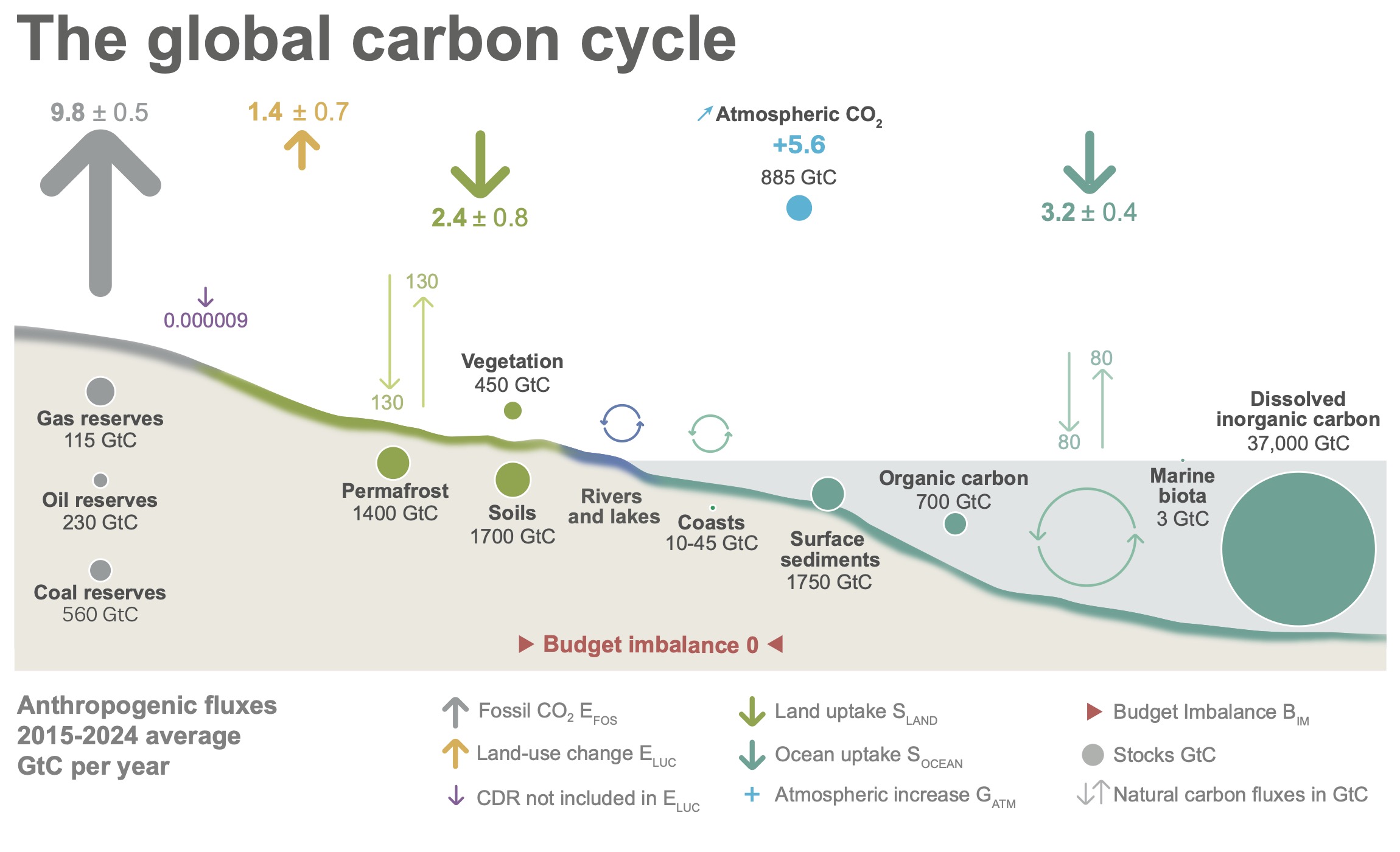
Schematic representation of the overall perturbation of the global carbon cycle caused by anthropogenic activities, averaged global for the most recent decade 2015-2024.
Carbon budget for 2024
For the year 2024, emissions from fossil fuel consumption increased by 1.1% relative to 2023, with net release to atmosphere at 10.3 ± 0.5 GtC yr-1 (including the cement carbonation sink, 0.2GtCyr-1), and that from land-use change was 1.3 ± 0.7 GtC yr-1. Thus, the total anthropogenic CO2 emissions stood at 11.6 ± 0.9 GtC yr-1 (42.4 ± 3.2 GtCO2 yr-1). For 2024, the atmospheric growth rate was 7.9 ± 0.2 GtC yr-1 (3.73 ± 0.1 ppm yr-1), about 2.2 GtC yr-1 above the 2023 growth rate. The ocean sink is estimated to be 3.4 ± 0.4 GtC yr-1, which is much greater than the global total land sink at 1.9 ± 1.1 GtC yr-1, leading to a large negative budget imbalance (-1.7 GtC yr-1), suggesting a large uncertainty remained. The global atmospheric CO2 concentration averaged over 2024 reached 422.8 ± 0.1 ppm.
Preliminary estimate of carbon budget for 2025*
Headline:Fossil CO2 emissions continue to rise in 2025 while the terrestrial sink recovers to pre-El Niño strength
-
Global CO2 emissions from fossil use are projected to rise 1.1% in 2025 (range 0.2% to 2.2%).
Emissions in China and India are projected to grow much less in 2025 compared to their growth over the past decade (2015-2024), while emissions in the USA and European Union are also projected to grow this year, partly due to weather conditions. -
Global CO2 emissions from land-use change are expected to decrease in 2025, driven by reductions in deforestation and degradation fires in South America.
Land-use change emissions have decreased since their peak in the late-1990s, in particular in the past decade. -
Total anthropogenic CO2 emissions – the sum of fossil and land-use change emissions – have grown more slowly in the past decade (0.3% per year on average), compared to the previous decade (1.9% per year).
Total emissions are projected to be 42.2 billion tonnes of CO2 in 2025, with the growth in fossil emissions offset by the decrease in land-use change emissions. -
The remaining carbon budget to limit global warming to 1.5°C is virtually exhausted.
With a warming of the planet attributed to human activities of 1.36°C in 2024, the remaining budget for 1.5°C is 170 GtCO2, equivalent to 4 years at the 2025 emissions levels. -
The land CO2 sink is set to recover to its pre-El Niño strength in 2025, after a strong decrease in 2024.
Based on a consolidation of the global carbon budget methodology, the land and ocean have taken up 21% and 29% of anthropogenic emissions in the past decade, respectively. -
The concentration of CO2 in the atmosphere is set to reach 425.7 parts per million in 2025.
Emerging climate impacts on the land and ocean carbon sinks contributed 8% to the rise in atmospheric CO2 concentration since 1960.
* Details are found in the press release
This year, the projection of fossil fuel emissions newly includes that of Japan
